







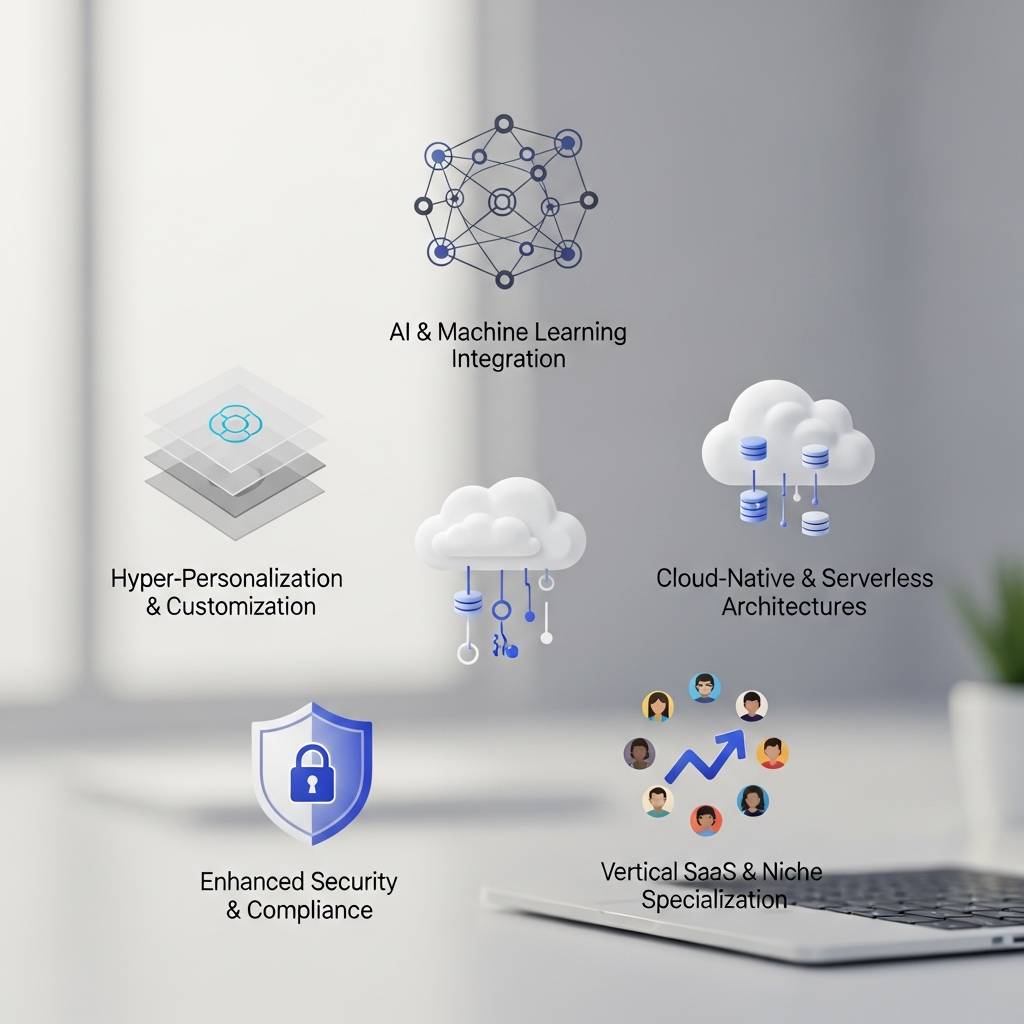
5 Essential Saas Trends: Ultimate Guide for 2024
The Software as a Service (SaaS) landscape is in a perpetual state of evolution, driven by technological advancements, shifting user expectations, and dynamic market demands. For businesses looking to stay competitive and innovative, understanding the key Saas Trends shaping 2024 is not just beneficial, it’s essential. This ultimate guide will delve into five pivotal Saas Trends that are set to redefine how software is developed, delivered, and consumed in the coming year, providing actionable insights for founders, developers, and decision-makers alike. Embracing these Saas Trends will be critical for long-term success and market relevance.
1. AI and Machine Learning Dominance in Saas Trends
Artificial Intelligence (AI) and Machine Learning (ML) are no longer futuristic concepts; they are fundamental components of modern SaaS applications. In 2024, the integration of AI/ML will move beyond simple automation to power predictive analytics, hyper-personalization, and intelligent decision-making across various industries. This profound shift is one of the most impactful Saas Trends we’re witnessing.
SaaS platforms are leveraging AI to automate repetitive tasks, enhance data processing capabilities, and provide deeper insights than ever before. From customer service chatbots that understand complex queries to sophisticated data analysis tools that identify patterns and anomalies, AI is transforming the user experience. Businesses that fail to incorporate intelligent features risk falling behind in a market increasingly defined by smart solutions.
Enhancing User Experience with AI-Powered Saas Trends
One of the most significant impacts of AI on Saas Trends is its ability to create more intuitive and responsive user experiences. AI algorithms can analyze user behavior, preferences, and historical data to offer personalized recommendations, streamline workflows, and anticipate user needs. For instance, an AI-powered CRM can suggest optimal sales strategies, or a marketing automation platform can dynamically adjust campaign parameters for better engagement.
Furthermore, AI is instrumental in improving the accessibility and efficiency of SaaS platforms. Natural Language Processing (NLP) allows users to interact with software using conversational interfaces, making complex tools more approachable. The ability of AI to process vast amounts of unstructured data also means that SaaS applications can extract valuable insights from text, voice, and images, unlocking new possibilities for innovation. This continuous evolution marks a significant point in current Saas Trends.
(Image alt text: AI-powered dashboard illustrating various Saas Trends data points)
The Rise of Predictive Analytics and Automation
Predictive analytics, fueled by advanced machine learning models, is another cornerstone of these Saas Trends. SaaS companies are using AI to forecast future outcomes, identify potential risks, and optimize resource allocation. This capability is invaluable for inventory management, financial forecasting, and even predicting customer churn, allowing businesses to proactively address challenges.
Automation, while not new, is reaching new heights with AI. Intelligent automation goes beyond simple rule-based systems to learn and adapt, continuously improving efficiency. This means less manual intervention, fewer errors, and more time for employees to focus on strategic tasks. Integrating AI-driven automation is a crucial step for SaaS providers aiming to deliver maximum value and stay ahead of the curve in the competitive landscape of Saas Trends.
2. Hyper-Personalization and Customer-Centricity as Key Saas Trends
In a crowded market, generic solutions no longer suffice. Customers expect experiences tailored to their specific needs and preferences. Hyper-personalization, driven by data and AI, is therefore becoming a defining characteristic of successful SaaS platforms. This focus on individual customer journeys is a powerful force among the current Saas Trends.
SaaS providers are moving beyond basic customization to offer dynamic, adaptable interfaces and features that evolve with the user. This means understanding not just what a user does, but why they do it, and proactively offering solutions that align with their goals. A truly customer-centric approach fosters loyalty and reduces churn, making it a vital strategy for any SaaS business.
Tailoring User Journeys with Data Insights
To achieve hyper-personalization, SaaS companies are investing heavily in data collection and analysis. By leveraging advanced analytics, they can segment users into highly specific groups and understand their individual behaviors. This granular understanding allows for the creation of unique user journeys, from onboarding to feature adoption and support interactions.
Consider a project management SaaS that adapts its dashboard layout based on a user’s role and typical workflow, or an e-commerce platform that curates product recommendations based on past purchases and browsing history across multiple channels. These examples highlight how data-driven personalization elevates the user experience, transforming it from a one-size-fits-all model to a bespoke service. This deeply personalized approach is a significant driver of modern Saas Trends.
Proactive Support and Engagement
Customer-centricity extends beyond product features to encompass proactive support and engagement. SaaS companies are using AI and data to anticipate customer issues before they arise, offering solutions or guidance preemptively. This might involve an in-app notification about a potential workflow bottleneck or an automated message with relevant tutorials based on recent activity.
The goal is to move from reactive problem-solving to proactive value delivery. By understanding customer pain points and aspirations, SaaS providers can build stronger relationships and ensure users continuously derive value from their subscriptions. This strategic shift towards proactive engagement is a clear indicator of the maturity of current Saas Trends.
(Image alt text: Customer journey map highlighting personalized Saas Trends interactions)
3. Vertical SaaS and Industry Specialization
While horizontal SaaS platforms (like Salesforce or Microsoft 365) cater to a broad range of businesses, a significant shift towards vertical SaaS is gaining momentum. Vertical SaaS solutions are specifically designed to meet the unique needs of a particular industry, offering highly specialized features, compliance capabilities, and integrations. This specialization is one of the most compelling Saas Trends for niche markets.
These tailored solutions often outperform general-purpose software in specific sectors because they address industry-specific challenges with precision. From healthcare and finance to construction and retail, vertical SaaS providers are carving out significant market shares by deeply understanding and serving their target audiences. This focus allows for deeper integration into industry workflows and regulatory requirements.
Deep Industry Expertise and Compliance
The primary advantage of vertical SaaS lies in its deep industry expertise. These platforms are built with an intimate understanding of a sector’s specific workflows, terminology, and regulatory landscape. For example, a vertical SaaS for healthcare might include HIPAA-compliant data handling, electronic health record (EHR) integration, and medical billing functionalities that a general CRM would lack.
Compliance with industry regulations (e.g., GDPR, CCPA, PCI DSS, HIPAA) is a major concern for many businesses. Vertical SaaS solutions often come pre-configured with these compliance features, significantly reducing the burden on their clients. This specialized compliance makes them an attractive option for businesses operating in highly regulated environments, solidifying their position among the impactful Saas Trends.
Targeted Integrations and Ecosystems
Vertical SaaS platforms also excel at providing targeted integrations with other industry-specific tools and services. Instead of offering a vast array of generic integrations, they focus on building robust connections with the applications most relevant to their niche. This creates a cohesive ecosystem that streamlines operations and enhances data flow within a particular industry.
For example, a vertical SaaS for restaurants might integrate seamlessly with popular food delivery apps, point-of-sale (POS) systems, and inventory management software designed for the food service industry. This level of specialized integration ensures that businesses can manage their entire operations within a unified, purpose-built ecosystem, making them a powerful force in the landscape of Saas Trends.
4. Composable SaaS and API-First Architectures
The demand for flexibility and agility is driving the adoption of composable SaaS, an approach where applications are built from interchangeable, modular components. This paradigm shift, often underpinned by API-first architectures, allows businesses to select and combine best-of-breed services to create highly customized and adaptable solutions. This modularity is a critical development in current Saas Trends.
Instead of relying on monolithic suites, companies can now “compose” their ideal software stack by integrating various specialized SaaS products via APIs. This not only offers greater flexibility but also reduces vendor lock-in and allows businesses to quickly adapt to changing market conditions. The rise of composable architecture is fundamentally altering how enterprises approach their digital infrastructure.
The Power of Modular Components for Saas Trends
Composable SaaS leverages the concept of microservices, where individual functionalities are developed and deployed independently. This modularity means that if one component needs updating or replacing, it can be done without affecting the entire system. For businesses, this translates to faster innovation cycles and the ability to swap out underperforming tools for better alternatives without disrupting operations.
An API-first approach ensures that these components can communicate seamlessly. APIs (Application Programming Interfaces) act as standardized connectors, allowing different software systems to talk to each other. This enables businesses to build highly customized workflows by connecting various SaaS tools, creating a truly unique and efficient operational environment. This architectural evolution is a key element of modern Saas Trends.
(Image alt text: Diagram showing various Saas Trends modules connected via APIs)
Flexibility and Future-Proofing for Businesses
One of the biggest advantages of composable SaaS is the unparalleled flexibility it offers. Businesses are no longer constrained by the limitations of a single vendor’s suite. They can pick the best email marketing tool, the best CRM, the best analytics platform, and integrate them all to work together harmoniously. This empowers organizations to build a technology stack that perfectly aligns with their specific needs and strategic goals.
Furthermore, composable SaaS offers a degree of future-proofing. As technology evolves and new, superior tools emerge, businesses can easily integrate them into their existing stack without a complete overhaul. This agility ensures that companies can remain competitive and responsive in a rapidly changing digital landscape, making it a strategic imperative among emerging Saas Trends.
5. Emphasis on Data Security and Privacy in Saas Trends
With increasing data breaches and stringent regulations like GDPR and CCPA, data security and privacy have moved from being an afterthought to a core differentiator for SaaS providers. Customers are more aware than ever of the importance of protecting their data, and they expect SaaS platforms to prioritize robust security measures. This heightened focus is a non-negotiable aspect of current Saas Trends.
In 2024, SaaS companies must demonstrate a proactive and transparent approach to security, embedding privacy-by-design principles into their development processes. Trust is the ultimate currency in the digital economy, and a strong security posture builds that trust, making it a critical aspect of all Saas Trends.
Building Trust Through Robust Security Measures
SaaS providers are implementing advanced security protocols, including multi-factor authentication (MFA), end-to-end encryption, and regular security audits. Beyond technical measures, there’s a growing emphasis on security awareness training for employees and clear communication with users about data handling practices. This holistic approach is vital for maintaining customer confidence.
Compliance with international and industry-specific security standards (e.g., ISO 27001, SOC 2) is also becoming a baseline expectation. SaaS companies that can demonstrate adherence to these rigorous standards gain a significant competitive edge, reassuring customers that their sensitive data is in safe hands. This commitment to security is a hallmark of responsible Saas Trends.
Privacy-by-Design and User Control
Privacy-by-design is a fundamental principle in modern SaaS development. This means incorporating privacy considerations from the very initial stages of product conceptualization, rather than treating them as an add-on. It involves minimizing data collection, anonymizing data where possible, and providing users with granular control over their information.
Giving users control over their data—what is collected, how it’s used, and who it’s shared with—is crucial for fostering trust. Transparent privacy policies, easy-to-use privacy settings, and clear data consent mechanisms are becoming standard features. SaaS companies that empower users with data control will distinguish themselves in a market where data privacy concerns are paramount, setting a high bar for future Saas Trends.
(Image alt text: Shield icon representing data security and privacy in Saas Trends)
Conclusion: Navigating the Future of Saas Trends
The SaaS industry is dynamic and ever-evolving, and staying abreast of the latest Saas Trends is paramount for sustained success. The five essential Saas Trends discussed – AI and Machine Learning dominance, hyper-personalization, vertical SaaS, composable architecture, and a strong emphasis on data security and privacy – collectively paint a picture of a more intelligent, tailored, flexible, and secure future for software. These Saas Trends are not just predictions; they are already shaping the landscape.
By integrating AI and ML, SaaS platforms will become more intuitive and efficient, offering unparalleled insights and automation. Hyper-personalization will deepen customer relationships, ensuring solutions are precisely aligned with user needs. Vertical SaaS will continue to address niche markets with specialized expertise, while composable architecture will provide the flexibility businesses need to adapt and innovate rapidly. Finally, unwavering commitment to data security and privacy will be the foundation upon which trust and loyalty are built.
Embracing these transformative Saas Trends is crucial for any business aiming to thrive in 2024 and beyond. It’s an opportunity to innovate, differentiate, and deliver exceptional value to customers. To learn more about how these Saas Trends can impact your specific business model or to explore bespoke SaaS development solutions, contact our experts today. Let’s build the future of SaaS together!