







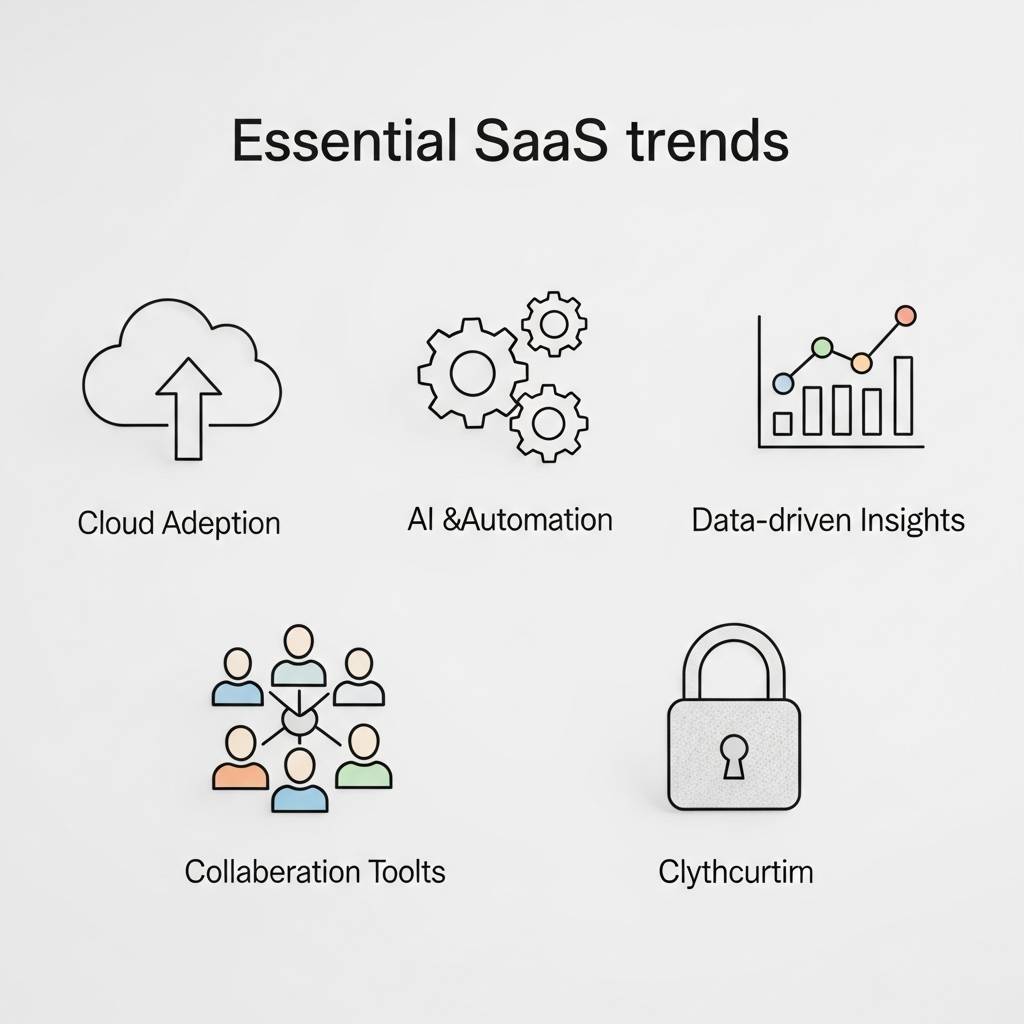
The Software-as-a-Service (SaaS) industry is a dynamic and rapidly evolving landscape, constantly reshaping how businesses operate and innovate. Staying ahead in this competitive environment requires more than just a great product; it demands a keen understanding and proactive adaptation to the prevailing shifts. For entrepreneurs, investors, and businesses leveraging cloud solutions, recognizing and integrating the most impactful SaaS Trends is not just beneficial—it’s absolutely essential for ultimate success and long-term viability. These trends dictate market direction, influence customer expectations, and open new avenues for growth and differentiation.
In this comprehensive guide, we’ll explore five essential SaaS Trends that are currently dominating the industry and are poised to define its future. From artificial intelligence to sustainable practices, understanding these shifts will empower you to make informed decisions, optimize your strategies, and ensure your SaaS venture thrives in the years to come.
Understanding the Evolving Landscape of SaaS Trends
The SaaS market continues its impressive growth trajectory, fueled by digital transformation initiatives across all sectors. As technology advances and user expectations shift, the nature of successful SaaS offerings also transforms. Keeping a pulse on these changes is paramount. Ignoring emerging SaaS Trends can lead to stagnation, while embracing them can unlock unprecedented opportunities for innovation and market leadership.
The rapid pace of technological innovation, coupled with an increasingly competitive market, means that today’s cutting-edge feature can quickly become tomorrow’s standard expectation. Businesses that actively monitor and adapt to the latest SaaS Trends are better positioned to meet customer needs, streamline operations, and build resilient, future-proof solutions. Let’s delve into the five pivotal trends shaping the SaaS world right now.
1. AI and Machine Learning Integration: A Dominant SaaS Trend
Artificial Intelligence (AI) and Machine Learning (ML) are no longer futuristic concepts; they are integral components of modern SaaS applications. This isn’t just about adding a fancy feature; it’s about fundamentally enhancing product capabilities, user experience, and operational efficiency. The integration of AI/ML is arguably one of the most impactful SaaS Trends we’re witnessing today.
The Impact of AI on SaaS Products
AI is revolutionizing SaaS across various functions. It enables hyper-personalization, automates repetitive tasks, and provides predictive insights that were previously unattainable. In customer relationship management (CRM) software, AI can predict customer churn, suggest optimal sales strategies, and automate lead scoring. For marketing automation platforms, AI personalizes content delivery, optimizes campaign timing, and analyzes performance with greater accuracy. Customer support SaaS solutions leverage AI-powered chatbots and virtual assistants to provide instant, 24/7 support, resolving common queries and freeing human agents for more complex issues. These advancements are transforming how businesses interact with their customers and manage their internal processes, setting new benchmarks for what users expect from modern SaaS Trends.
Challenges and Opportunities in this SaaS Trend
While the benefits are clear, integrating AI also presents challenges. Data privacy and security, ethical AI development, and the need for specialized talent are significant hurdles. However, the opportunities far outweigh these difficulties. SaaS providers that effectively harness AI can gain a significant competitive advantage, offering superior user experiences and unprecedented operational efficiencies. AI-driven analytics can uncover deep insights into user behavior, enabling continuous product improvement and more targeted feature development. Companies like Salesforce with Einstein AI, or HubSpot with its AI tools, demonstrate the power of embedding intelligence directly into core business applications. (Image Alt Text: AI-powered SaaS Trends dashboard showing analytics and predictions)
Embracing AI isn’t just about technological adoption; it’s about rethinking product strategy and user value. This particular set of SaaS Trends is driving a new era of intelligent automation and personalized experiences across the board.
2. Hyper-Personalization and Customer-Centricity
In an increasingly crowded market, generic solutions no longer suffice. Customers expect experiences tailored to their specific needs, preferences, and workflows. This shift towards hyper-personalization and deep customer-centricity is another powerful force among current SaaS Trends, moving beyond basic customization to truly understand and anticipate user requirements.
Tailoring Experiences with Current SaaS Trends
Hyper-personalization goes beyond merely addressing a user by their first name. It involves leveraging data analytics to understand individual user behavior, preferences, and pain points throughout their entire journey. This means tailoring onboarding flows, recommending features based on usage patterns, providing context-aware support, and even customizing UI elements. For example, project management SaaS might highlight features most relevant to a user’s role or industry, while an e-commerce platform built on SaaS principles might dynamically adjust its interface based on past browsing and purchase history. This level of detail makes users feel understood and valued, significantly enhancing their experience and loyalty to the product. These sophisticated SaaS Trends are all about creating a bespoke feel for every user.
Building Stronger Relationships through SaaS Trends
Customer-centricity isn’t just about personalization; it’s about putting the customer at the heart of every business decision, from product development to support. This involves proactive customer success initiatives, gathering continuous feedback, and building communities around your product. Companies excelling in this area often see higher customer lifetime value (LTV) and reduced churn rates. Investing in robust customer success teams and tools is no longer optional; it’s a critical differentiator. (For deeper insights, explore SaaS customer success strategies.) This focus on the customer experience is a foundational element of successful SaaS Trends, ensuring that products evolve in lockstep with user needs and expectations.
3. Vertical SaaS and Niche Specialization
While horizontal SaaS solutions cater to a broad range of industries, a growing number of providers are finding immense success by focusing on specific verticals. This specialization, known as Vertical SaaS, is one of the most compelling SaaS Trends, offering tailored solutions that deeply integrate with the unique workflows and regulatory requirements of a particular industry.
Why Vertical SaaS Trends are Gaining Momentum
Vertical SaaS targets specific industries like healthcare, real estate, construction, legal, or hospitality. Instead of offering a general CRM, a Vertical SaaS might provide a CRM specifically designed for medical practices, integrating with electronic health records (EHR) systems and adhering to HIPAA compliance. This deep specialization allows these solutions to offer unparalleled functionality, industry-specific integrations, and compliance features that generic horizontal tools simply cannot match. Businesses in these niches often find immediate value in tools that “speak their language” and address their precise pain points without extensive customization. This precision is a major driver behind these focused SaaS Trends.
Advantages for Businesses Following these SaaS Trends
The benefits of Vertical SaaS are multifaceted. For providers, it often leads to higher customer retention rates, as the solution is deeply embedded in the customer’s core operations and difficult to replace. Marketing efforts can be more targeted and cost-effective, as the ideal customer profile is clearly defined. Customers, in turn, benefit from solutions that are purpose-built for their industry, reducing implementation time and increasing efficiency. According to a report by Lightspeed Venture Partners, vertical SaaS companies often exhibit higher gross margins and lower churn compared to their horizontal counterparts, highlighting the financial viability of these particular SaaS Trends. This strategic focus allows for building stronger relationships and becoming an indispensable partner within a specific ecosystem.
4. Embedded SaaS and API-First Approaches
The desire for seamless, integrated experiences is driving another significant shift: the rise of embedded SaaS and API-first development. This trend is about breaking down silos and allowing SaaS functionalities to be seamlessly integrated into other applications or platforms, making services more accessible and less disruptive. It’s a foundational change in how we think about product delivery within the broader landscape of SaaS Trends.
The Rise of Embedded SaaS Trends
Embedded SaaS refers to the integration of a specific SaaS functionality directly into another application or workflow, often without the user realizing they are interacting with a third-party service. Think of a banking platform offering embedded accounting software, or an e-commerce site providing integrated shipping label generation. This creates a unified user experience, eliminating the need to switch between multiple applications. It often manifests as “as-a-service” offerings like Banking-as-a-Service (BaaS) or Payments-as-a-Service, where core functionalities are exposed via APIs for other businesses to embed. This approach enhances the value proposition of the host application while extending the reach of the embedded SaaS provider. These are truly transformative SaaS Trends that are redefining user workflows.
API-First as a Foundation for Future SaaS Trends
Underpinning the embedded SaaS movement is an API-first development strategy. This means designing products with the assumption that their functionalities will be accessed and integrated by other systems via robust, well-documented Application Programming Interfaces (APIs). An API-first approach prioritizes developer experience, ensuring that external developers can easily connect, extend, and build upon the SaaS platform. This fosters an ecosystem of complementary services and integrations, expanding the utility and stickiness of the core product. Companies that adopt an API-first mindset are more agile, scalable, and better equipped to participate in the interconnected digital economy. (Image Alt Text: API integration SaaS Trends diagram showing various connected services) This strategy is crucial for companies looking to lead the next wave of SaaS Trends.
5. Sustainable SaaS and ESG Considerations
As global awareness of environmental, social, and governance (ESG) factors grows, so does the demand for sustainable business practices. The SaaS industry, heavily reliant on vast data centers and energy consumption, is increasingly being scrutinized for its environmental footprint. Consequently, sustainable SaaS and ESG considerations are emerging as crucial SaaS Trends that influence both operational strategies and consumer choices.
Green Initiatives Driving New SaaS Trends
SaaS providers are beginning to adopt more eco-friendly practices, from optimizing data center energy efficiency to sourcing renewable energy for their operations. This includes investing in carbon-neutral cloud infrastructure, implementing green coding practices to reduce computational load, and offering transparent reporting on their environmental impact. Beyond direct environmental efforts, the “S” (social) and “G” (governance) aspects of ESG are also gaining traction. This involves fair labor practices, diversity and inclusion initiatives, data privacy commitments, and ethical AI development. These new SaaS Trends reflect a broader corporate responsibility movement.
The Business Case for Sustainable SaaS Trends
Adopting sustainable practices is not just about corporate social responsibility; it’s also a smart business move. Customers, particularly younger generations and B2B clients, are increasingly prioritizing vendors with strong ESG credentials. Investors are also factoring ESG performance into their decision-making, favoring companies with robust sustainability strategies. A study by Nielsen found that 66% of consumers are willing to pay more for sustainable brands. By embracing sustainable SaaS Trends, companies can enhance their brand reputation, attract top talent, comply with evolving regulations, and potentially unlock new market segments. It’s a strategic imperative that aligns profitability with planetary well-being.
Navigating the Future: Key Takeaways from these SaaS Trends
The SaaS industry is a vibrant ecosystem where innovation is constant and adaptation is key. The five essential SaaS Trends we’ve explored—AI/ML integration, hyper-personalization, vertical specialization, embedded SaaS/API-first approaches, and sustainable practices—are not isolated phenomena. They are interconnected forces that collectively shape the future of cloud software. Understanding their nuances and strategic implications is vital for anyone operating within or looking to enter this dynamic market.
To truly succeed, SaaS providers must look beyond simply implementing new technologies. They must integrate these SaaS Trends into their core business philosophy, ensuring their products, processes, and culture are aligned with the evolving demands of the market and society. Agility, foresight, and a relentless focus on delivering value will be the hallmarks of successful SaaS companies in the coming years.
Conclusion
The SaaS landscape is continuously transforming, driven by technological advancements and shifting customer expectations. By embracing these essential SaaS Trends—AI and Machine Learning, hyper-personalization, vertical specialization, embedded SaaS, and sustainability—businesses can not only survive but thrive. These trends represent powerful opportunities to innovate, differentiate, and build more resilient and customer-centric solutions.
Staying informed and proactively integrating these insights into your strategy will be critical for maintaining a competitive edge. Don’t just observe these shifts; become an active participant in shaping the future of SaaS. Are you ready to leverage these critical SaaS Trends to propel your business to ultimate success? Start evaluating how these trends can be woven into your product roadmap and operational strategies today to ensure you’re at the forefront of the next wave of innovation.