







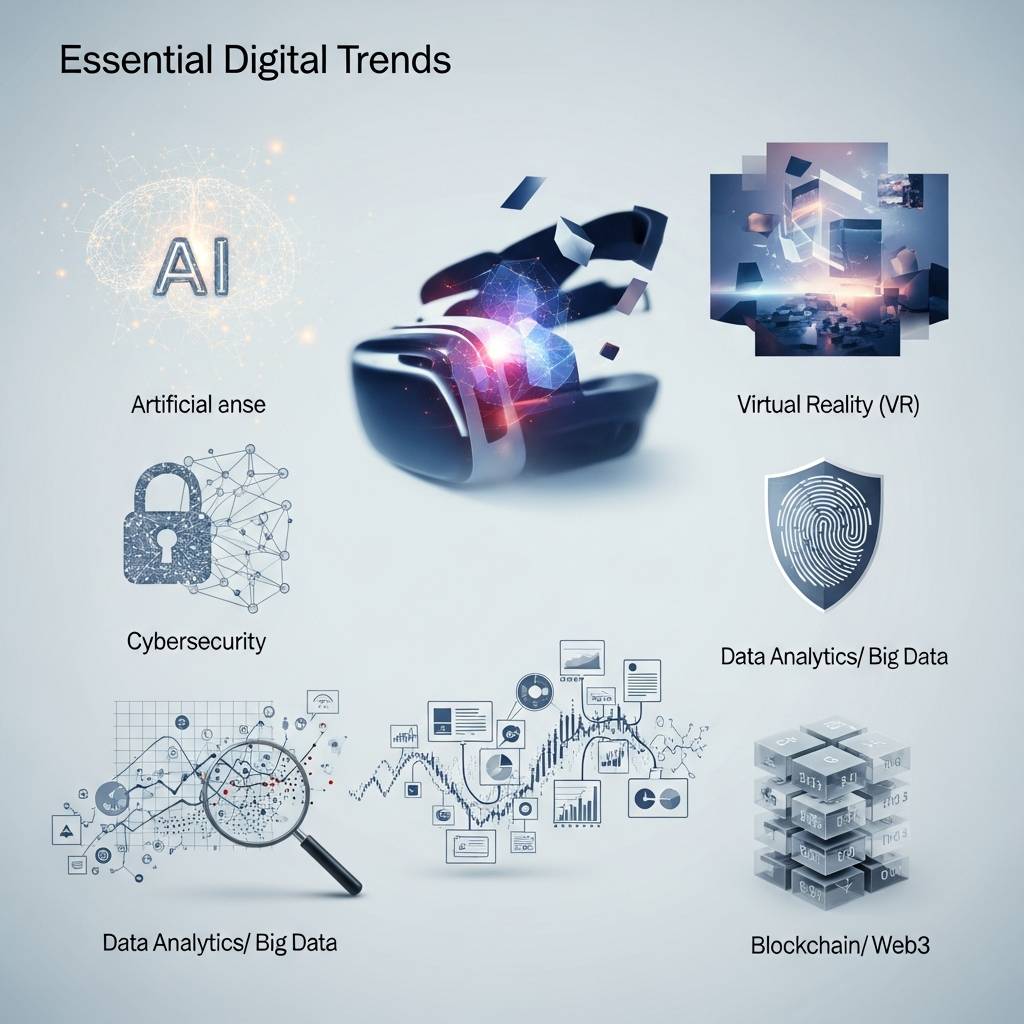
5 Essential Digital Trends: Proven Strategies
In today’s rapidly evolving technological landscape, staying ahead of the curve is not just an advantage—it’s a necessity. The pace of innovation means that what was cutting-edge yesterday might be obsolete tomorrow. Understanding and strategically leveraging the most impactful Digital Trends is paramount for businesses and individuals alike to thrive and remain competitive. From the way we work and interact to how we consume information and make purchasing decisions, these overarching shifts are reshaping our world. This comprehensive guide will delve into five essential Digital Trends that are currently dominating the global tech conversation, offering proven strategies to help you navigate and capitalize on their immense potential.
The Rise of Artificial Intelligence & Generative AI: Mastering New Digital Trends
Artificial Intelligence (AI) is no longer a futuristic concept; it’s a pervasive reality, and Generative AI, in particular, represents one of the most transformative Digital Trends of our time. Tools like ChatGPT, Midjourney, and DALL-E have democratized AI capabilities, allowing for the creation of text, images, code, and even music from simple prompts. This shift is fundamentally altering how content is produced, how data is analyzed, and how businesses interact with their customers.
The impact of AI extends across virtually every industry, from healthcare and finance to marketing and education. According to a report by PwC, AI could contribute up to $15.7 trillion to the global economy by 2030, highlighting its massive potential. Businesses that embrace AI are seeing significant gains in efficiency, personalization, and innovation. The key is not just adopting AI, but integrating it thoughtfully into existing workflows and strategies.
Proven Strategies for Leveraging AI in Modern Digital Trends
To effectively harness the power of AI, consider these actionable strategies:
1. Automate Routine Tasks with AI
Identify repetitive and time-consuming tasks within your operations, such as data entry, customer service inquiries, or report generation. Implementing AI-powered automation can free up human resources to focus on more complex, strategic initiatives. For instance, AI chatbots can handle a significant portion of customer support, improving response times and satisfaction. Explore tools for robotic process automation (RPA) to streamline backend operations.
(Image Alt Text: Diagram illustrating AI-powered automation workflows in a business, showcasing efficiency gains, a key aspect of current digital trends.)
2. Enhance Content Creation with Generative AI
Generative AI tools can significantly boost content production. Marketers can use AI to draft blog posts, social media updates, email campaigns, and even video scripts. Graphic designers can leverage AI to generate unique images or variations of existing designs. While human oversight remains crucial for quality and brand voice, AI can serve as a powerful co-pilot, accelerating the content pipeline. This is one of the most exciting Digital Trends for creative industries.
(Image Alt Text: A person using a generative AI tool to create digital art and marketing copy, demonstrating new digital trends in content creation.)
3. Personalize Customer Experiences
AI excels at analyzing vast amounts of data to identify patterns and predict user behavior. Use AI to deliver highly personalized experiences, from product recommendations on e-commerce sites to customized marketing messages. AI-driven analytics can segment audiences more effectively, ensuring that content and offers are relevant to individual preferences, thereby enhancing customer loyalty and engagement. This level of personalization is a defining characteristic of advanced Digital Trends.
Hyper-Personalization & Customer Experience (CX): Driving Digital Trends Forward
In an increasingly crowded marketplace, customer experience (CX) has emerged as a primary differentiator. Consumers expect seamless, intuitive, and highly personalized interactions across all touchpoints. Hyper-personalization, powered by advanced data analytics and AI, takes this a step further, delivering tailored experiences that anticipate needs and preferences. This focus on the individual customer journey is a critical component of modern Digital Trends.
A Salesforce report indicates that 80% of customers say the experience a company provides is as important as its products and services. Businesses that invest in CX and hyper-personalization not only retain customers but also foster stronger brand loyalty and advocacy. Understanding customer behavior at an granular level allows for proactive engagement and the creation of truly memorable interactions.
Strategies for Elevating CX Through Hyper-Personalization
To excel in hyper-personalization, consider these approaches:
1. Leverage Data for 360-Degree Customer Views
Integrate data from all customer touchpoints—website visits, purchase history, social media interactions, customer service calls—into a unified platform (CRM). This creates a 360-degree view of each customer, enabling a deeper understanding of their journey and preferences. This comprehensive data is the foundation for effective hyper-personalization and a key enabler of many Digital Trends.
2. Implement Predictive Analytics for Proactive Engagement
Utilize predictive analytics to anticipate customer needs and potential issues before they arise. For example, if a customer frequently purchases a certain product, offer a discount or related items just before they might run out. Proactively addressing potential pain points or offering relevant solutions significantly enhances the customer experience and builds trust. This foresight is a hallmark of cutting-edge Digital Trends.
3. Personalize Communication Across Channels
Ensure that all communication—emails, website content, app notifications, in-store interactions—is personalized based on individual data. Use dynamic content that changes based on user behavior and demographics. Beyond just using a customer’s name, tailor the messaging, offers, and even the imagery to resonate directly with their unique profile. Consistent, personalized messaging across channels is vital for cohesive Digital Trends strategies.
(Image Alt Text: A dashboard showing personalized customer data and engagement metrics, illustrating hyper-personalization in action, a core element of modern digital trends.)
The Immersive Web: Metaverse, AR/VR as Emerging Digital Trends
The concept of the immersive web, encompassing technologies like the Metaverse, Augmented Reality (AR), and Virtual Reality (VR), is rapidly moving from science fiction to practical application. These technologies promise to transform how we work, learn, socialize, and shop by creating persistent, interactive, and often three-dimensional digital environments. While still in its nascent stages, the immersive web represents significant future Digital Trends.
Companies like Meta (formerly Facebook) are heavily investing in the Metaverse, envisioning a future where digital and physical worlds seamlessly blend. AR overlays digital information onto the real world (think Pokémon Go or IKEA Place), while VR creates entirely simulated environments (like Oculus Quest games or virtual training simulations). These platforms offer unprecedented opportunities for engagement and new forms of commerce.
Strategies for Exploring the Immersive Web
To prepare for and engage with the immersive web, consider these strategies:
1. Experiment with AR for Enhanced Product Experiences
For retailers, AR can allow customers to virtually “try on” clothes, place furniture in their homes, or visualize products in their own environment before purchasing. This reduces returns and boosts customer confidence. AR apps are relatively accessible to develop and can provide immediate value by bridging the gap between online browsing and real-world application. This practical application of AR is a key aspect of evolving Digital Trends.
2. Explore VR for Training and Collaboration
VR offers powerful solutions for training simulations, particularly in high-risk industries or for complex procedures. It also provides immersive environments for remote collaboration, making distributed teams feel more connected. Businesses can create virtual meeting rooms or showrooms, offering engaging alternatives to traditional video conferencing. Consider how VR can enhance skills development and team cohesion, reflecting innovative Digital Trends in the workplace.
(Image Alt Text: People wearing VR headsets interacting in a virtual meeting room, showcasing the immersive web as a new digital trend for collaboration.)
3. Establish a Presence in Emerging Metaverse Platforms
While the Metaverse is still evolving, businesses can begin experimenting with establishing a presence in existing platforms like Decentraland or The Sandbox. This could involve creating virtual stores, hosting events, or developing unique digital assets (NFTs). Early adoption allows for learning and experimentation without significant investment, positioning your brand at the forefront of these exciting Digital Trends.
Data Privacy, Security & Ethical AI: Navigating Crucial Digital Trends
As technology advances and more data is collected, the importance of data privacy, cybersecurity, and ethical AI practices has never been higher. Consumers are increasingly aware of their digital footprints and demand greater control over their personal information. Regulatory frameworks like GDPR and CCPA underscore the legal and ethical imperative for robust data protection. Addressing these concerns is a non-negotiable aspect of responsible Digital Trends adoption.
Cybersecurity threats are growing in sophistication and frequency, making strong defenses essential. Furthermore, the ethical implications of AI—such as algorithmic bias, transparency, and accountability—are critical considerations. Businesses must not only protect data but also ensure that their AI systems are fair, unbiased, and used responsibly.
Strategies for Robust Data Privacy, Security & Ethical AI
To build trust and ensure compliance, implement these strategies:
1. Implement a “Privacy by Design” Approach
Integrate privacy considerations into the design and architecture of all new systems, products, and services from the outset. This means minimizing data collection, anonymizing data where possible, and building in strong security measures by default. Proactive privacy measures are far more effective than reactive fixes and align with best practices for managing modern Digital Trends.
2. Strengthen Cybersecurity Defenses with Zero-Trust
Adopt a zero-trust security model, which assumes that no user or device, whether inside or outside the network, should be trusted by default. Every access attempt must be verified. Implement multi-factor authentication (MFA), regular security audits, employee training, and invest in advanced threat detection systems to protect against evolving cyber threats. Robust security is foundational to navigating complex Digital Trends.
(Image Alt Text: A padlock icon overlaid with digital data streams, symbolizing strong cybersecurity and data privacy, essential for managing digital trends.)
3. Develop Ethical AI Guidelines and Governance
Establish clear ethical guidelines for the development and deployment of AI systems. This includes addressing potential biases in data sets, ensuring transparency in algorithmic decision-making, and implementing human oversight. Regular audits of AI systems for fairness and accuracy are crucial to building public trust and avoiding unintended consequences. Ethical AI is a critical dimension of responsible Digital Trends.
Sustainable & Green Technology: Eco-Conscious Digital Trends
As global environmental concerns intensify, sustainability has become a critical factor influencing all industries, including technology. Sustainable and Green Technology focuses on minimizing the environmental impact of digital operations, from energy consumption in data centers to the lifecycle of electronic devices. This growing emphasis on eco-friendly practices is one of the most vital and long-term Digital Trends.
Consumers and investors are increasingly prioritizing companies with strong environmental, social, and governance (ESG) practices. Embracing green tech not only benefits the planet but also enhances brand reputation, reduces operational costs, and attracts environmentally conscious talent. The tech industry, with its significant energy demands, has a unique opportunity and responsibility to lead in this area.
Strategies for Adopting Sustainable Digital Trends
To integrate sustainability into your tech operations, consider these strategies:
1. Optimize Data Center Efficiency
Data centers are major energy consumers. Implement strategies to improve their energy efficiency, such as using renewable energy sources, optimizing cooling systems, and virtualizing servers to reduce physical hardware. Migrating to cloud providers that prioritize green infrastructure can also significantly reduce your carbon footprint, aligning with sustainable Digital Trends.
2. Promote Sustainable Hardware Lifecycle Management
Extend the lifespan of electronic devices through repair, reuse, and responsible recycling programs. Choose hardware manufacturers with strong sustainability credentials and consider using refurbished equipment where appropriate. Minimize e-waste by implementing clear end-of-life policies for all digital assets. This contributes to a circular economy, a core tenet of responsible Digital Trends.
(Image Alt Text: Green leaves sprouting from a circuit board, symbolizing sustainable technology and eco-friendly digital trends.)
3. Develop Eco-Conscious Digital Products and Services
Design digital products and services with sustainability in mind. This includes optimizing code for energy efficiency, reducing data transfer requirements, and making digital content accessible to prolong its relevance. For example, streaming services can offer lower-bandwidth options, and websites can be optimized for faster loading times, reducing energy consumption on the user’s end. These thoughtful design choices reflect a commitment to sustainable Digital Trends.
Conclusion: Mastering the Future of Digital Trends
The digital landscape is a dynamic and ever-changing frontier, shaped by powerful and interconnected Digital Trends. From the transformative power of AI and the imperative of hyper-personalization to the immersive possibilities of the Metaverse, the critical need for data privacy, and the growing importance of sustainable technology, these shifts demand attention and strategic action. Businesses and individuals who proactively understand and adapt to these trends will not only survive but thrive in the coming years.
Embracing these Digital Trends requires continuous learning, strategic investment, and a willingness to innovate. By implementing the proven strategies outlined above, you can harness the power of these technological advancements to drive efficiency, enhance customer experiences, foster innovation, build trust, and contribute to a more sustainable future. The time to act is now, to ensure your place at the forefront of the digital revolution.
Ready to leverage these essential Digital Trends for your business? Start by assessing your current digital capabilities and identifying which trends offer the most immediate and long-term benefits. Explore our other articles on AI strategy implementation or customer experience best practices for more in-depth guidance. Don’t let the future pass you by—embrace these digital shifts and turn them into your competitive advantage today!